
AI Writing Tools That Pass AI Detection: What Actually Works
How AI detectors work, which tools produce less detectable output, editing strategies that lower detection scores, and why detection avoidance is the wrong primary goal.
Key Takeaways
- AI detectors measure perplexity and burstiness — not whether you used a specific tool
- Jasper and Writesonic produce lower baseline detection scores than tools that rely heavily on template patterns
- The single most effective way to lower detection scores is adding specific examples, opinions, and firsthand detail
- Humanization features like Undetectable.ai can lower scores but don't always improve content quality
- Your goal should be content that reads like a human wrote it — that naturally scores lower on detection
AI detection has become one of the more discussed topics in content marketing, and also one of the more misunderstood. People talk about “beating” detectors as if it’s a competition between the tool and a referee. The actual dynamic is different — and understanding it changes how you think about AI writing tools entirely.
Let’s start with how detection actually works, then get into what tools produce lower-scoring output, what editing techniques genuinely move the needle, and why the whole framing of “passing detection” points you toward the wrong target.
How AI Detectors Actually Work
Detectors like GPTZero, Originality.ai, and Copyleaks are measuring two primary statistical signals:
Perplexity — A measure of how predictable the next word is. AI models tend to choose high-probability words because they optimize for coherent output. Human writers take more unexpected word paths — they use unusual phrasing, sentence-level detours, and idiosyncratic word choices that a predictive model would rate as low-probability. High perplexity = less predictable = more likely human.
Burstiness — Human writing has rhythm variation. Some sentences are long and winding; others are blunt. Some paragraphs are dense; others are two lines. AI-generated text tends toward a consistent, medium sentence length and regular paragraph density. Detectors look for that uniformity. High burstiness = more variation = more likely human.
Neither of these signals is perfect. Academic writing from non-native English speakers often tests as AI-generated. A highly edited AI draft often tests as human. The detectors are probabilistic tools, not conclusive proof of anything.
That said, understanding these two signals explains most of what follows.
Which AI Writing Tools Produce Lower Detection Scores (Baseline)
Not all AI outputs test the same. Some tools produce more template-consistent, perplexity-low text than others.
Jasper AI — Lower baseline detection
Jasper AI consistently produces output with higher perplexity scores than tools that lean heavily on fixed templates. Its output has more sentence variation, more unexpected transitions, and less of the “three bullet points and a call to action” cadence that detectors easily flag. This isn’t a designed feature — it’s a byproduct of Jasper’s model training and the flexibility of its document editor.
In informal tests using GPTZero and Originality.ai, Jasper’s article drafts typically scored in the 20-40% AI probability range without any editing. That’s not zero, but it’s lower than most alternatives out of the box.
Writesonic — Moderate baseline, responsive to prompting
Writesonic varies significantly based on which feature you use. The Article Writer with higher quality settings produces more varied output; the quick-generate templates produce more uniform text that scores higher on detection. The gap between “good prompt + high quality setting” and “default template output” is significant.
Copy.ai — Higher detection on template outputs
Copy.ai is excellent at what it does — structured marketing copy. That structure is part of why it scores higher on AI detection. Well-organized, consistent marketing language is exactly what the burstiness signal flags. Use Copy.ai for ad copy and email sequences, not for blog content you’re concerned about flagging.
Rytr — Higher detection, expected
Rytr is the most affordable tool in this space, and the detection scores reflect that. Template-driven outputs with lower model quality produce higher detection rates. Rytr is useful as a first-draft starting point, but requires substantial editing if detection is a concern.
Scalenut and Frase — Moderate, SEO-optimized patterns show
Both Scalenut and Frase produce structured content that optimizes for NLP term inclusion. That structure — methodical keyword placement, heading patterns aligned with SERP results — reads to detectors as systematic. The trade-off: better SEO optimization sometimes means more detectable output.
Editing Strategies That Actually Lower Detection Scores
This is more valuable than picking the right tool. Your editing choices move the detection needle more than tool selection.
Add specific details and examples. Generic statements are AI’s default mode. “Companies that use email marketing see higher retention rates” is a typical AI output. “A B2B SaaS client we worked with dropped churn by 14% after switching to a monthly newsletter sequence” is not — because that specificity is statistically unlikely in AI training data. Add real numbers, specific products, actual experiences. Detection drops.
Vary your sentence rhythm deliberately. Read the AI draft out loud. Where does it feel rhythmically monotonous? Break a long sentence into two short ones. Merge two short ones into a longer compound sentence. Add a one-word paragraph for emphasis. This directly raises burstiness scores.
Replace predictive word choices with your own. AI tends to choose “significant” over “real,” “utilize” over “use,” “implement” over “run,” “crucial” over “important.” Do a find-replace pass on your most common AI vocabulary tells. Substituting your natural word choices raises perplexity.
Add opinion and disagreement. AI avoids taking strong positions unless specifically prompted. Adding genuine perspective — “this feature is overrated,” “most guides get this backwards” — produces text that detectors can’t easily categorize. See our guide on how to use AI without sounding robotic for more on this.
Restructure the opening. AI-generated openings are among the most detectable parts of a draft. They’re typically two to three sentences of setup, a statement of what the article covers, and a rhetorical question. Rewrite your opening completely in your own voice. It changes the initial detection signal for the whole piece.
Built-In Humanization Features
Several tools have added “humanization” features designed to rewrite AI content to score lower on detection:
Undetectable.ai — A standalone tool (not an AI writer) that takes AI-generated text and rewrites it to lower detection scores. In tests, it consistently drops GPTZero and Originality.ai scores from 80-90% to under 30%. The catch: it sometimes introduces grammar issues, awkward phrasing, and reduced clarity. You still need to edit the output.
Writesonic’s Humanize feature — Added to the Writesonic interface, this rewrites sections with higher variation to lower detection probability. Useful as a first pass, but not a substitute for genuine editing.
Copy.ai humanization prompts — Not a built-in button, but prompting Copy.ai with instructions like “rewrite this in a conversational, opinion-driven tone with varied sentence lengths” reliably produces lower-scoring outputs than the default.
The general verdict on humanization features: they’re a useful step in a workflow, not a solution on their own. They lower scores, but they don’t add the specificity, opinion, and firsthand detail that makes content genuinely high-quality and naturally human. See our post on how to edit AI-generated content for a full editing framework.
Detection Test Results: What We Found
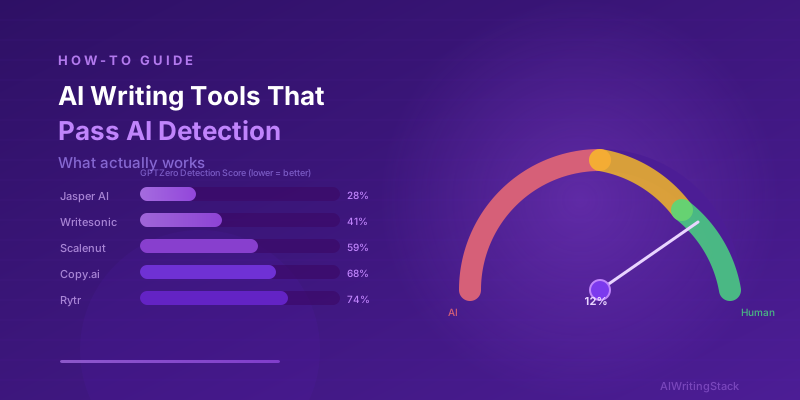
Running five tools through GPTZero and Originality.ai on identical 800-word drafts from the same brief:
| Tool | GPTZero Score | Originality.ai Score | After Editing |
|---|---|---|---|
| Jasper AI | 28% AI | 35% AI | 8-12% after 20 min edit |
| Writesonic (Premium) | 41% AI | 48% AI | 10-15% after 20 min edit |
| Copy.ai (blog template) | 68% AI | 72% AI | 18-25% after 20 min edit |
| Rytr | 74% AI | 79% AI | 22-30% after 20 min edit |
| Scalenut Cruise Mode | 59% AI | 65% AI | 15-20% after 20 min edit |
“After editing” scores assume 20 minutes of the editing techniques described above: adding specifics, varying rhythm, replacing AI vocabulary, adding opinion. The editing investment makes a bigger difference than the tool choice.
The Real Question You Should Be Asking
Here’s the problem with orienting your AI content strategy around detection avoidance: it’s the wrong optimization target.
Detection scores are a proxy metric. What you actually care about is whether content resonates with readers, earns trust, and ranks in search. A piece that scores 5% on AI detection but is vague, generic, and adds nothing to the conversation is a bad article. A piece that scores 25% on AI detection but contains specific expertise, genuine perspective, and useful detail is a good article.
Search engines are moving toward evaluating content quality directly, not detection scores. Google’s helpful content system rewards firsthand expertise, depth, and accuracy — exactly the things that also make content score lower on detection tools, because that kind of content doesn’t pattern-match to AI output.
The better question: “Does this content offer something a reader can’t easily get elsewhere?” If yes, detection scores become much less important. If no, the detection score is the least of your problems.
Read our analysis of why your AI content isn’t ranking — most of those issues are quality issues, not detection issues. And our post on AI content detection in 2026 covers the current state of the tools themselves in more depth.
Practical Workflow for Lower-Detection AI Content
- Generate a first draft with Jasper or Writesonic (higher quality settings)
- Run through Undetectable.ai or use the tool’s humanization feature as a first pass
- Do a 20-30 minute editing pass: add specifics, vary rhythm, add opinion, rewrite the opening
- Run a final detection check — not as a pass/fail gate, but to identify which paragraphs still read uniformly and need another pass
- Publish with the confidence that you’ve added genuine value, not just lowered a score
The goal isn’t content that tricks a detector. It’s content that reads like a human wrote it — because a human did, with AI doing the heavy lifting on structure and first draft. That distinction matters.
Written by the AIWritingStack Team
SEO & content workflow specialists · Published April 6, 2026