Best AI Writing Tools for Long-Form Blog Content
Comparing Jasper, Writesonic, Frase, and Surfer AI for 1500+ word articles — document editors, outline workflows, consistency issues, and when AI first drafts actually save time.
Key Takeaways
- Jasper's document editor is the strongest environment for long-form drafting — consistent tone across 2000+ words
- Frase is best for SEO long-form where research depth matters more than prose quality
- Chat-based generation (ChatGPT-style) is faster for short sections but loses consistency across long articles
- AI drifts in quality after roughly 800 words in a single generation — break long articles into sections
- Fact-checking is non-negotiable for long-form AI content — errors compound across longer pieces
Generating a 150-word social caption with AI is straightforward. Generating a coherent, well-argued 2,500-word article is a fundamentally different task — and most AI writing tools weren’t designed with it in mind.
The challenges compound with length: tone shifts mid-article, points repeat, the structure loses its thread, and factual accuracy becomes harder to verify across more claims. The tools covered here have actually solved enough of these problems to be useful for long-form content production. Others have not.
What Long-Form Content Requires From an AI Tool
Before the rankings, here’s what actually matters at 1,500+ words:
Document editor, not just generation snippets. Chat-based generation gives you outputs you have to assemble manually. A true document editor lets you build the article in one environment, move sections, regenerate specific parts, and maintain context across the whole piece.
Outline-to-article workflow. The best long-form AI workflows start with an outline the writer controls, then generate content section by section against that outline. This prevents the AI from inventing structure and keeps the article on its intended track.
Tone and context persistence. AI models don’t natively “remember” what they wrote 800 words ago. Tools that handle long-form well either use larger context windows or reload previous content as context before generating new sections. Without this, the second half of an article sounds different from the first.
Accuracy mechanisms. Long articles contain more claims, more statistics, and more specific assertions. Tools that can pull from real sources, let you insert verified facts, or flag uncertain information are more useful for long-form than pure generators.
1. Jasper AI — Best Document Editor for Long-Form
Jasper AI built its document editor specifically for long-form content production, and it shows. The editor lets you write alongside the AI — type a heading, hit the command to generate, review the output, then continue. The AI takes your existing content into account when generating new sections, which reduces the tone drift problem significantly.
The brand voice feature matters more in long-form than short. A 2,000-word article that changes personality midway is noticeably off. Jasper’s brand voice profiles keep the AI aligned to your defined tone for the full length of the document.
Outline-to-article workflow in Jasper:
- Write your H1 and H2 structure manually
- Under each H2, write one sentence describing what that section should cover
- Use the “Compose” command to generate each section
- Review and edit before moving to the next section
- Write the intro and conclusion manually for strongest voice consistency
This approach — letting the AI fill in sections against a human-controlled outline — consistently produces better results than full-article generation. The human editorial judgment stays in the process; the AI handles the drafting labor.
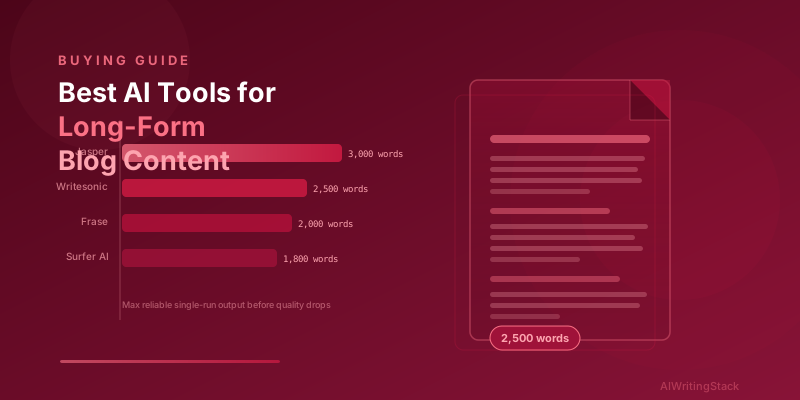
Length ceiling: Jasper handles 2,000-3,000 word articles well in this workflow. At 4,000+ words, you’ll notice more context drift. Break very long content into two documents and stitch them together for editing.
Pricing: Creator plan at $49/month, Pro at $69/month per seat. Long-form content production is well within the Creator plan.
2. Frase — Best for Research-Backed Long-Form
Frase approaches long-form differently. Before writing a word, Frase pulls the top 20 results for your target keyword and maps the topics they cover, the questions they answer, and the average section structure. You’re building your outline against real competitive data.
This research phase is where Frase earns its cost. A 2,500-word article built from a Frase brief will cover the topics that matter for the query — not topics the AI invented based on its training data. The content is better informed by design.
The AI writing itself is competent but not Jasper-level polished. Frase is explicit about this: it’s a research and optimization tool with AI writing built in, not an AI writer with research bolted on. For SEO-focused long-form where accuracy and topic coverage matter more than prose style, Frase is the right call.
Long-form workflow in Frase:
- Enter target keyword, let Frase pull SERP data
- Review competitor content map, add questions from PAA boxes
- Build your outline using Frase’s topic suggestions
- Use the AI writer section-by-section against the outline
- Check the NLP optimization score and add missing terms
- Do a factual accuracy review before publishing
The output needs editing — more so than Jasper. Budget 45-60 minutes of editing per 1,500-word article. The research phase saves you time on the other end by eliminating rewrites for missing topics.
Pricing: Pro plan at ~$45-$50/month. Exceptional value for SEO long-form.
3. Writesonic Article Writer — Best Automated First Draft
Writesonic offers the most automated long-form generation of any tool in this comparison. Its Article Writer takes a title and keyword, generates an outline, lets you adjust it, then produces a complete 1,500-2,500 word article in a single run.
The speed is real. A complete article draft in 3-5 minutes is possible. The quality is also real — on the “Premium” quality setting, Writesonic produces some of the better automated long-form output available, with reasonable structure and less obvious AI cadence than lower-tier tools.
The limitation: single-run generation at long lengths drifts more than section-by-section generation. The second half of Writesonic articles tends to be weaker than the first — more repetition, more generic statements, less specific support. For a 1,500-word article, this is manageable. For a 3,000-word piece, plan on heavier editing in the back half.
Best use case for Writesonic long-form: Topics where you need a competent first draft quickly, you’ll be editing substantially anyway, and you’re producing at volume. It’s not the tool for your cornerstone content. It’s the tool for producing 20 supporting articles per month efficiently.
Pricing: Individual plan at $20/month covers the Article Writer. Chatsonic Pro at $40/month (approximately) expands quality limits.
4. Surfer AI — Best for Long-Form That Needs to Rank
Surfer AI generates long-form articles directly optimized against live SERP data. Enter a keyword, get an article calibrated to match the length, heading structure, and NLP terms of the current top results.
For long-form content where the primary goal is organic search performance, this approach has real merit. You’re not guessing at what to cover — the tool tells you what the top results include and writes to fill those requirements.
The trade-off: Surfer AI articles are built around optimization signals, which means the prose sometimes reads like it was assembled around keyword placement rather than written for a reader. Quality varies more than Jasper. Some articles need light editing; others need significant work.
Where Surfer AI long-form shines: Informational content for moderately competitive keywords. Product comparisons. How-to guides with clear structure requirements. Content where you can identify what ranks and write to match the pattern.
Where it struggles: Opinion pieces, brand storytelling, and any content where a distinctive voice matters more than SERP optimization.
Pricing: Plans start at $99/month, which includes the AI writer and content editor.
Document Editor vs Chat-Based Generation: The Practical Difference
Many writers try to produce long-form content through chat-based interfaces — GPT-4, Claude, or Gemini through their standard interfaces, or chat modes in AI writing tools. Here’s the honest comparison for long-form work:
Chat-based generation advantages:
- Fast for individual sections
- Easy to ask follow-up questions or request revisions on specific parts
- Good for research conversations and outline development
Chat-based generation disadvantages for long-form:
- No persistent document to edit in
- Context window limitations at very long lengths
- Assembling sections from separate chat outputs is tedious
- No integration with word count, structure tools, or SEO scoring
Document editor advantages:
- One environment for generation and editing
- AI references existing content for context
- Inline regeneration without copy-pasting
- Integrated word count and structure tools
For articles under 800 words, chat-based works fine. For anything you’re calling “long-form” — 1,500 words and up — a document editor is meaningfully more efficient. The tools ranked here all provide real document environments.
Fact-Checking and Accuracy: The Long-Form Problem
This deserves its own section because it’s where AI long-form content fails most visibly.
AI writing tools generate plausible-sounding text. At 500 words, fact-checking a few statistics is manageable. At 2,500 words, you may have 15-20 specific claims — dates, percentages, product features, quotes, company names, research findings — and any of them might be hallucinated.
The pattern is consistent across all tools: statistics are often wrong or slightly off, studies are cited but distorted, product features are sometimes mixed up between competing tools. The tools that minimize this are ones that source content from actual web research (Frase, Surfer AI with web access) rather than generating purely from training data.
Practical fact-checking workflow for long-form AI content:
- Highlight every specific claim, statistic, or citation in the draft
- Verify each one independently — don’t trust AI sources
- Replace unverifiable claims with verified data or remove them
- Add your own firsthand knowledge to support major claims
This adds 15-30 minutes to the editing process but is non-negotiable. Publishing AI-generated long-form content without fact-checking it is how you end up with correction notices.
See our guide on how to edit AI-generated content for the full editing workflow.
When to Use AI for the Full First Draft vs Section-by-Section
Use AI for the full first draft when:
- The topic is well-covered and factual accuracy is low-risk
- You’re producing at volume and editing is your main value-add
- The article follows a predictable structure (how-to, list, comparison)
- You need a fast starting point and plan to rewrite substantially
Use AI section-by-section when:
- The topic requires nuance or specific expertise
- Brand voice consistency is critical
- The article covers complex or sensitive territory
- You want to maintain editorial control throughout
Most experienced AI content workflows land somewhere between these — AI generates the structural sections (H2 body content), while the writer drafts the intro, conclusion, and any sections requiring genuine opinion or expertise. That division of labor produces the best results fastest.
For building a repeatable workflow around this, see our post on how to write blog posts with AI and how to build a content workflow with AI.
The Bottom Line
For long-form blog content, the tool matters less than the workflow. The writers who produce the best AI-assisted long-form aren’t the ones with the most expensive tool — they’re the ones who control the outline, generate section-by-section, fact-check every claim, and edit with a clear sense of what the reader actually needs.
That said, tool choice does matter at the margins. For quality: Jasper. For SEO research depth: Frase. For automated speed: Writesonic. For search-optimized output: Surfer AI. Match the tool to what your specific long-form content needs most.
Before committing to a tool, see our Jasper vs Writesonic comparison for a direct head-to-head on the two most popular long-form options, and the AI writing tool pricing breakdown to understand total cost at scale.
Written by the AIWritingStack Team
SEO & content workflow specialists · Published April 6, 2026