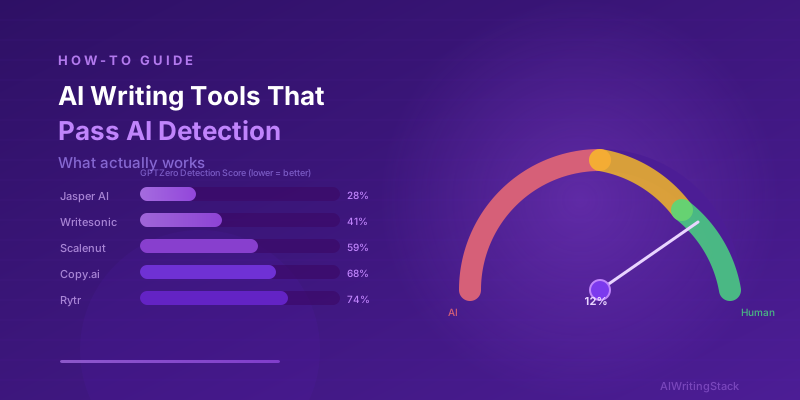
How-To
AI Writing Tools That Pass AI Detection: What Actually Works
How AI detectors work, which tools produce less detectable output, editing strategies that lower detection scores, and why detection avoidance is the wrong primary goal.
Affiliate Disclosure:This site contains affiliate links. If you make a purchase through our links, we may earn a commission at no extra cost to you. This funds our independent testing and reviews.Learn more
We spent $12,000+ on AI writing tool subscriptions so you don't pick the wrong one. Every tool tested inside real content workflows with real deadlines.
Editor's Choice
We trained Jasper on a fintech client's 15-page brand guide and the output actually sounded like their marketing team wrote it. No other tool matched that level of voice consistency across 20+ content pieces. The $49/mo price stings for solo users, but for teams producing multi-channel campaigns, the time savings on brand enforcement alone cover the cost.
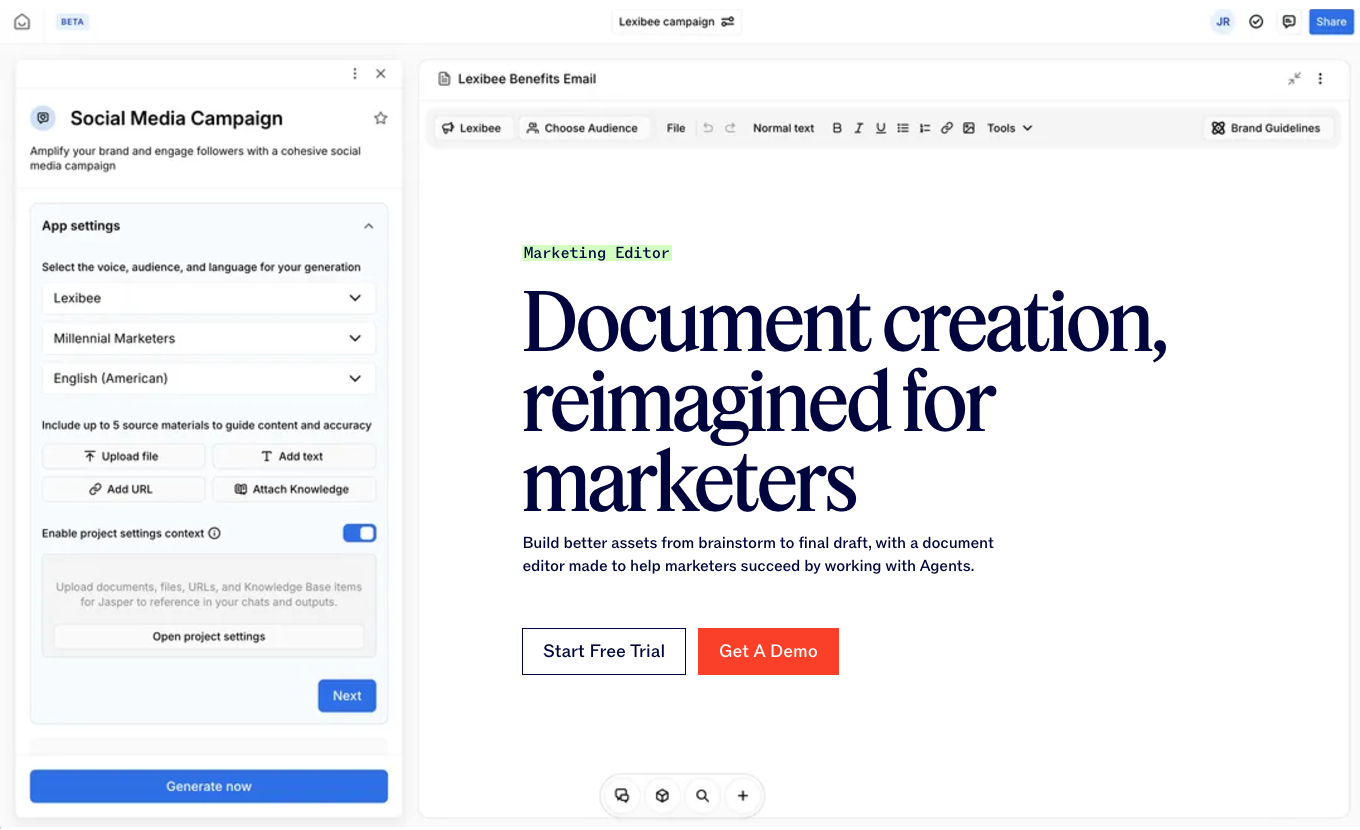
Jasper AI's content editor in action
3-week evaluation per tool. Scored on output quality (30%), ease of use (20%), pricing (20%), SEO capabilities (15%), and support (15%). See our methodology →
Copy.ai's workflow automation is the real differentiator. We built a cold outreach sequence that pulled prospect data and generated personalized 3-email sequences — what took our SDR team 20 minutes per prospect dropped to 90 seconds. The free plan with 2,000 words/month is generous enough to actually evaluate the tool, not just peek at it.
At $20/month, Writesonic punches above its weight. Article Writer 6.0 walked us through topic → title → outline → draft, and the step-by-step control produced better results than one-shot generators. The catch: output quality varies between sessions. A tech explainer generated Monday might be detailed and well-structured, while the same prompt Wednesday produced something shallow.
Rytr does one thing well: it gets words on the page fast and cheap. At $9/month for unlimited characters, it's less than a fifth of Jasper's price. The trade-off is real — long-form content needs heavy editing, and there's no brand voice training. But for product descriptions, social posts, and email drafts where speed matters more than polish, it earns its place.
Anyword is the only tool that tells you how your copy might perform before you publish it. We generated 10 Google Ads headline variations and the top-scored options consistently used stronger verbs and clearer benefit statements. The Custom AI Models feature — trained on your own campaign data — is unlike anything else in this category. Skip it for blog posts; use it for everything with a click-through rate.
Frase flips the AI writing process on its head — research first, write second. Its SERP analyzer pulled the top 20 results for our target keywords and showed exactly which subtopics, questions, and angles the ranking pages covered. The AI writing itself is average, but the research briefs saved us 2+ hours per article on competitive keywords. Best for teams who already know how to write and need smarter research.
Surfer AI produced a 2,500-word article on 'best project management software' that scored 78/100 on their content editor out of the box. That same score used to take us 3 rounds of manual optimization. The per-article pricing ($29 each) makes sense for teams producing 10-15 SEO articles monthly, but gets expensive fast beyond that.
Scalenut bundles keyword research, AI writing, and content optimization into one $39/month subscription — replacing 2-3 separate tools. Cruise Mode generated a 1,800-word article in under 4 minutes, but the output hit the right topics without going deep enough to stand out. Think of it as a solid starting point that needs a human editor with subject expertise to finish the job.
| Product | Best For | Free Plan | SEO Tools | Brand Voice | Languages | Price | |
|---|---|---|---|---|---|---|---|
 Jasper AI 4.7 | Marketing teams and content agencies | 7-day trial | Surfer SEO integration | Yes | 30+ | $49/mo | Try Jasper Free |
 Copy.ai 4.5 | Sales teams and copywriters | 2,000 words/mo | Limited | Yes | 29+ | Free / $49/mo | Try Copy.ai Free |
 Writesonic 4.3 | SEO content creators and bloggers | 10,000 words | Built-in + Surfer | Yes | 25+ | Free / $20/mo | Try Writesonic Free |
 Rytr 4.0 | Budget-conscious writers and freelancers | 10,000 chars/mo | Basic keyword tool | Custom tones | 30+ | Free / $9/mo | Learn More |
 Anyword 4.4 | Data-driven marketers and performance teams | 7-day trial | Basic blog wizard | Yes + custom models | 30+ | $49/mo | Try Anyword Free |
 Frase 4.2 | SEO researchers and content strategists | $1 for 5-day trial | SERP analysis, briefs, scoring | Limited | 20+ | $15/mo | Try Frase Free |
 Surfer AI 4.3 | SEO-focused content teams and agencies | 7-day guarantee | Full suite (SERP, NLP, audit) | Yes | 12+ | $29/article | Try Surfer AI |
 Scalenut 3.9 | Content planning and SEO workflow | 7-day trial | Keyword planner, clusters, NLP | Yes | 30+ | $39/mo | Try Scalenut Free |
Every tool goes through a 3-week structured evaluation by our team. We generate 10 blog post drafts across 3 niches, test marketing copy across channels, evaluate SEO workflows, and contact customer support with real questions. Ratings reflect weighted criteria — not affiliate payouts.
10 blog drafts across B2B SaaS, e-commerce, and health niches. Scored on readability, accuracy, and editing time to publishable standard.
Time from signup to first usable output. Learning curve for advanced features. Interface clarity across desktop and mobile.
What you actually get per dollar. Hidden costs, word limits, feature gating, and annual vs. monthly pricing differences.
Built-in optimization tools, SERP analysis, keyword integration, and content scoring accuracy compared to Surfer/Frase benchmarks.
Response times, knowledge quality, documentation depth, and active user community resources.
We earn affiliate commissions on tools we recommend, but our rankings are based on test results — not payout rates. We've given low scores to high-commission tools. Read our full methodology · Affiliate disclosure
AI writing tools use large language models (GPT-4, Claude, Gemini) to generate, rewrite, or improve written content. You provide a prompt — a topic, a format, tone preferences — and the tool produces a draft. Most tools layer on features like templates, brand voice training, and SEO scoring on top of the base AI model.
For teams producing 10+ content pieces per month, typically yes. In our testing, AI tools cut first-draft creation time by 50-70%, though every piece still needed human editing for accuracy, voice, and depth. The ROI depends on your volume — a solo blogger publishing weekly might not justify $49/month, but a team publishing daily almost certainly will.
Google's official position (per their February 2023 guidance on AI content) is that content quality matters more than how it was produced. AI-generated content that is helpful, accurate, and demonstrates expertise can rank well. The risk is in publishing unedited AI output — it tends to be generic, lacks original insights, and won't satisfy Google's E-E-A-T (Experience, Expertise, Authoritativeness, Trustworthiness) standards.
Rytr and Copy.ai. Rytr has the simplest interface — pick a use case, enter your inputs, click generate. Copy.ai's free plan gives you 2,000 words/month with no time limit, so you can evaluate at your own pace. Both produce usable short-form content within minutes of signing up.
AI tools generate original text based on patterns learned during training — they don't copy-paste from sources. However, common phrases and widely-known information can produce output that overlaps with existing content. Tools like Jasper, Rytr, and Surfer AI include built-in plagiarism checkers (powered by Copyscape or Copyleaks) to catch these cases before publishing.
No. They're draft generators, not finished-product machines. AI tools lack personal experience, can't fact-check their own claims, and tend toward generic phrasing without human editing. The most effective workflow we've found: use AI for first drafts and structural outlines, then have a human editor add expertise, verify facts, inject personality, and cut the filler.
Free plans cap your output (1,000-10,000 words/month), use older AI models, and lock premium features like brand voice training and SEO tools behind paid tiers. Paid plans unlock higher or unlimited word counts, access to GPT-4-class models, team collaboration, and specialized features. The jump in output quality from free to paid is noticeable — especially for long-form content.
Tips, guides, and industry insights
How AI detectors work, which tools produce less detectable output, editing strategies that lower detection scores, and why detection avoidance is the wrong primary goal.
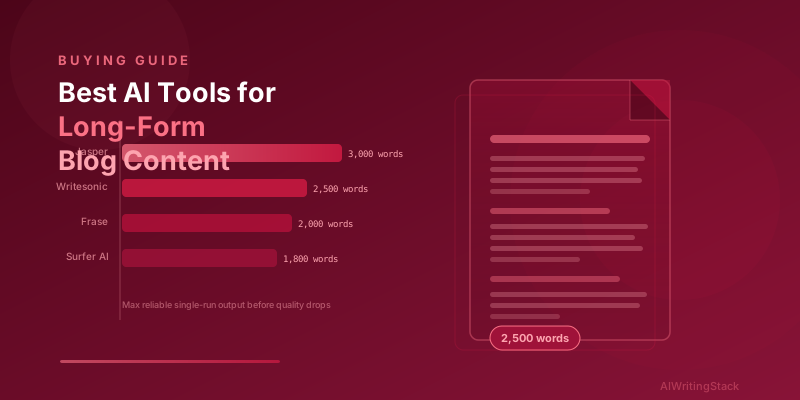
Comparing Jasper, Writesonic, Frase, and Surfer AI for 1500+ word articles — document editors, outline workflows, consistency issues, and when AI first drafts actually save time.
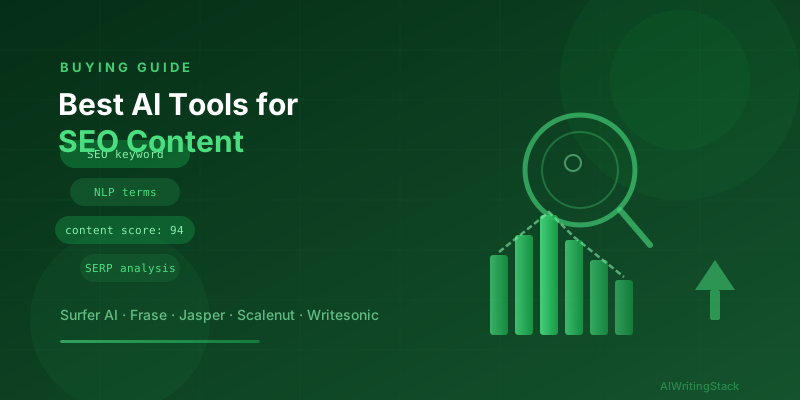
Ranked by actual SEO capability: SERP analysis, keyword integration, content scoring, and NLP optimization. For content marketers who need rankings, not just words.
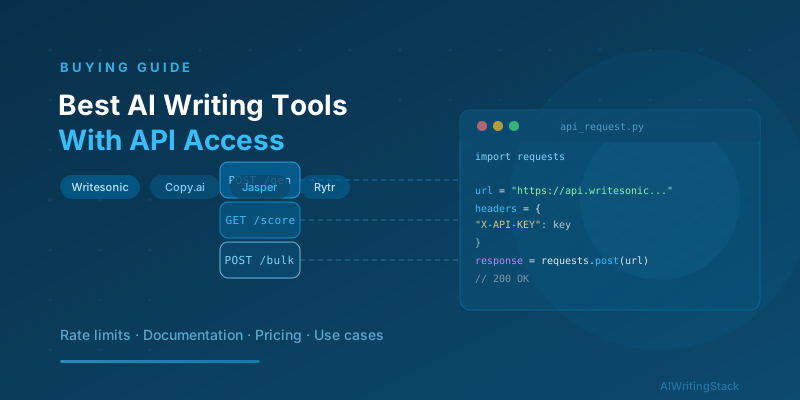
Which AI writing tools offer real developer APIs — pricing, rate limits, documentation quality, and use cases for programmatic content and CMS integration.
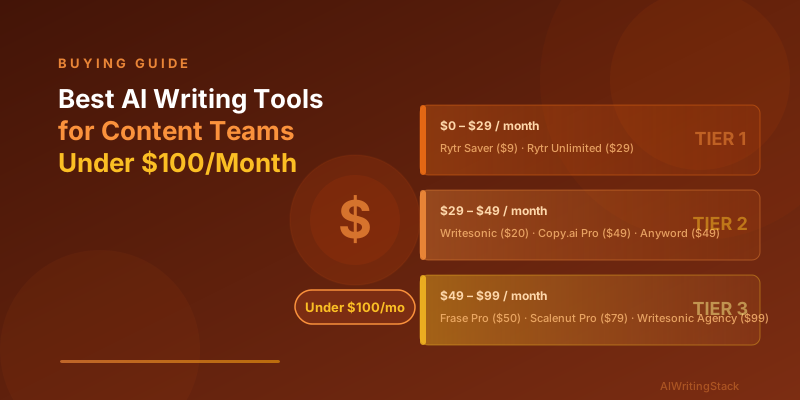
What you actually get at each price tier below $100/month — feature comparisons, word limits, team seats, and honest picks for small content teams on a budget.
Which AI writing tools actually help you create Amazon listings that rank and convert? We tested the top options for bullet points, A+ content, titles, and backend keywords.